
Catalina Starts Field Exploration at Kirkalocka Gold Project
Konrad Forrest
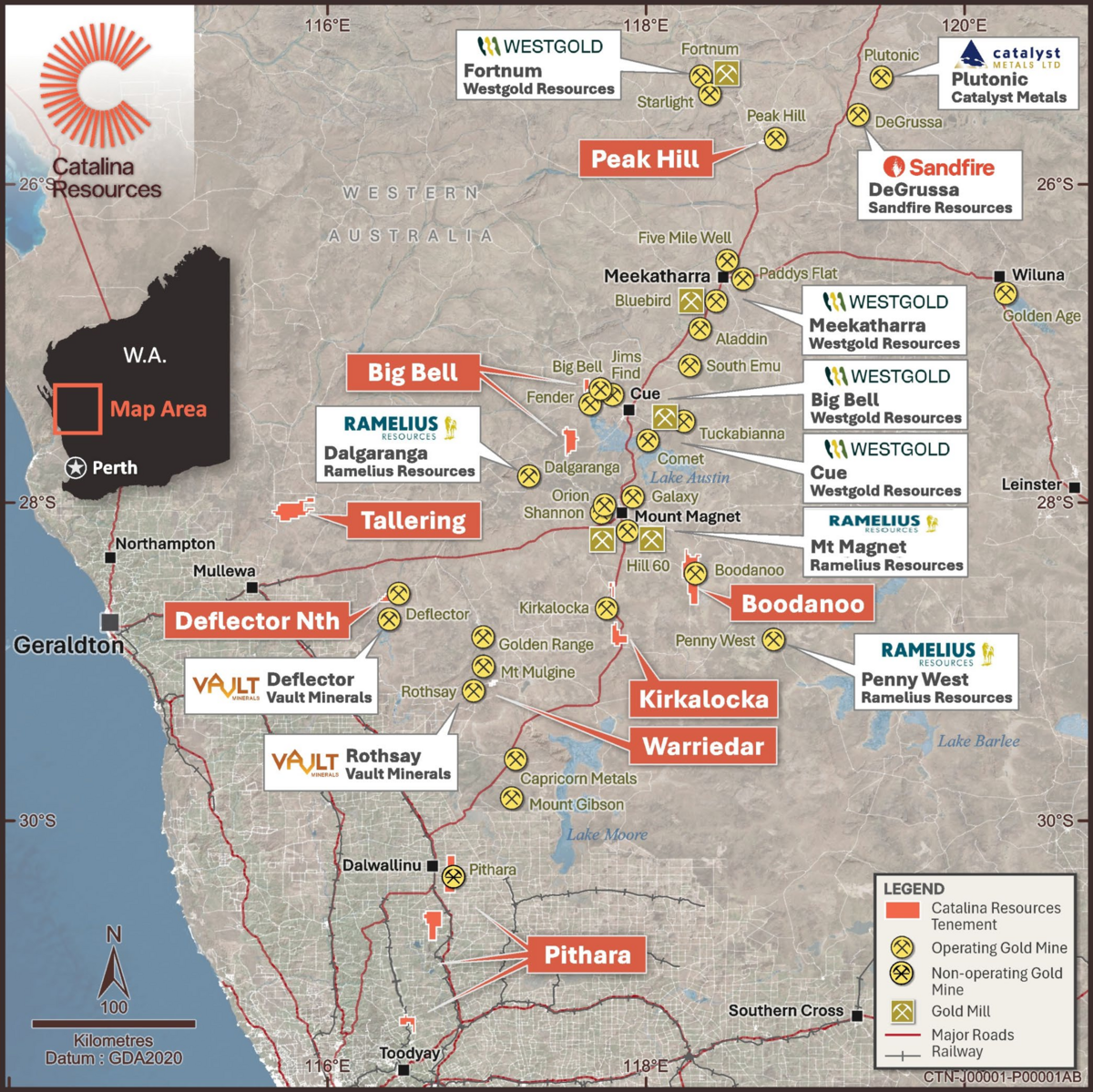
30 June 2026 | Western Australia - Catalina Resources has commenced field exploration at its Kirkalocka Gold Project in Western Australia, with a systematic gold-in-soil sampling program now underway.
The program includes approximately 1,500 soil samples across multiple priority target areas and marks the first major field activity following Catalina’s recent technical review of its Mid-West Gold Portfolio.
Catalina said the work is designed to refine historical gold anomalies, assess prospective structural corridors and generate high-quality reverse circulation drilling targets across the Kirkalocka Project.
The company’s technical review confirmed several historical gold mineralised zones, including:
- 6m at 1.38 g/t gold from 27m, including 3m at 1.40 g/t gold
- 6m at 1.79 g/t gold from 42m, including 3m at 3.02 g/t gold
- 1m at 4.66 g/t gold from 34m
Executive Director Ross Cotton said Catalina’s priority has been to rapidly move Kirkalocka from historical review toward drilling, with soil sampling now underway across several priority target areas.
He said the program includes Catalina’s tenure immediately adjacent to the Kirkalocka Gold Mine and processing hub, and is designed to generate high-quality RC drill targets.
Why it matters: Kirkalocka is strategically located in Western Australia’s Mid-West region, within the southern Wydgee-Meekatharra Greenstone Belt. The project sits directly adjacent to the Kirkalocka Gold Mine, which Catalina said has a Mineral Resource of approximately 240,000 ounces of gold, and is close to the Kirkalocka Gold Processing Plant, which has a capacity of 2Mtpa.
Catalina said the processing plant is being advanced toward recommencement in 2026 by Gylden Resources, giving the area existing infrastructure and potential future development relevance.
The company’s recent technical review identified multiple priority target areas characterised by historical gold anomalism, shallow gold mineralisation and interpreted structural corridors. Catalina said these areas remain only lightly tested by historical exploration.
The current soil sampling program will validate and improve historical geochemical datasets, refine known anomalies and assess structural trends. Results will be integrated with historical drilling, geological mapping and geophysical datasets to generate and rank targets for follow-up RC drilling.
Catalina has also completed field reconnaissance across priority target areas and received approval for its Eligible Mining Activity Notice, allowing the current exploration program to proceed.
Soil sampling and heritage assessment are now underway, with assay results expected to guide the company’s planned drilling program.
For Western Australia’s gold sector, Catalina’s Kirkalocka work adds another early-stage exploration story in the Mid-West, where historical gold results, nearby processing infrastructure and renewed field activity could support future drill testing.
Source: Catalina Resources ASX announcement, “Kirkalocka Advances Towards Drilling”, 30 June 2026.