
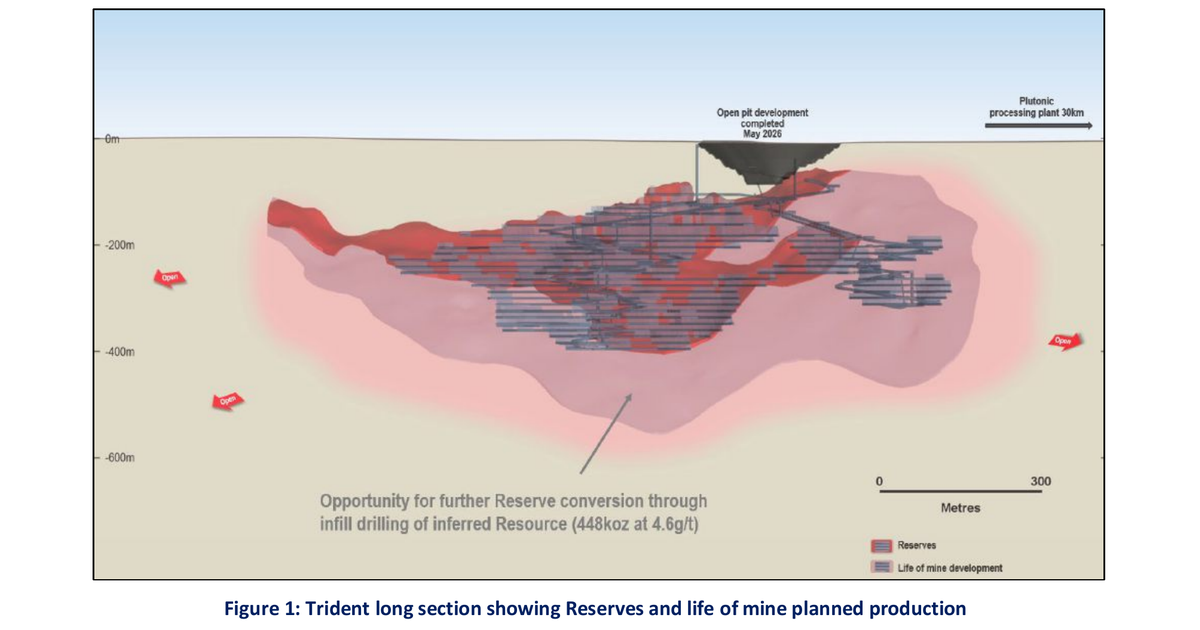
Catalyst Metals has increased the underground gold reserve at Trident by 32% to 524,000 ounces as development progresses on Western Australia's Plutonic Gold Belt.
The 14 September update reports a Probable Ore Reserve of 3.9 million tonnes at 4.2 grams per tonne gold. Underground development has reached 250 metres, with first underground ore expected in calendar 2027.
Development advances towards underground production
The completed Trident open pit provided access for the underground decline. Open-pit ore has been stockpiled for transport and processing at the existing Plutonic plant over the remainder of 2026.
Catalyst said grade-control drilling covering the first 15 months of production is complete. Trident has the required mining approvals and permits in place.
Infill drilling offers further reserve potential
Trident's previously announced Mineral Resource totals 1.081 million ounces, including 448,000 ounces classified as Inferred. Resources include Reserves; the two figures should not be added together. No Inferred Resource is included in the Ore Reserve.
Further infill drilling aims to convert more Inferred material to Indicated Resources and potentially Reserves. Any additional conversion remains dependent on drilling and assessment.
Catalyst expects Trident to provide a second higher-grade ore source for Plutonic, with a planned steady-state production range of 60,000 to 80,000 ounces a year. The company cautioned that its September 2025 long-term guidance is a general guide and will be updated as project and operating conditions change.
The development milestone supports planning across underground mining, geology and technical services. Specific vacancies and recruitment timing remain for Catalyst to confirm.
Source: Catalyst Metals, Trident Reserve grows by 30%, 14 September 2026.