
9 July 2026 | Western Australia - Cyprium Metals has reported extensive copper mineralisation within the waste dump at its Nifty Copper Complex in Western Australia’s Paterson region.
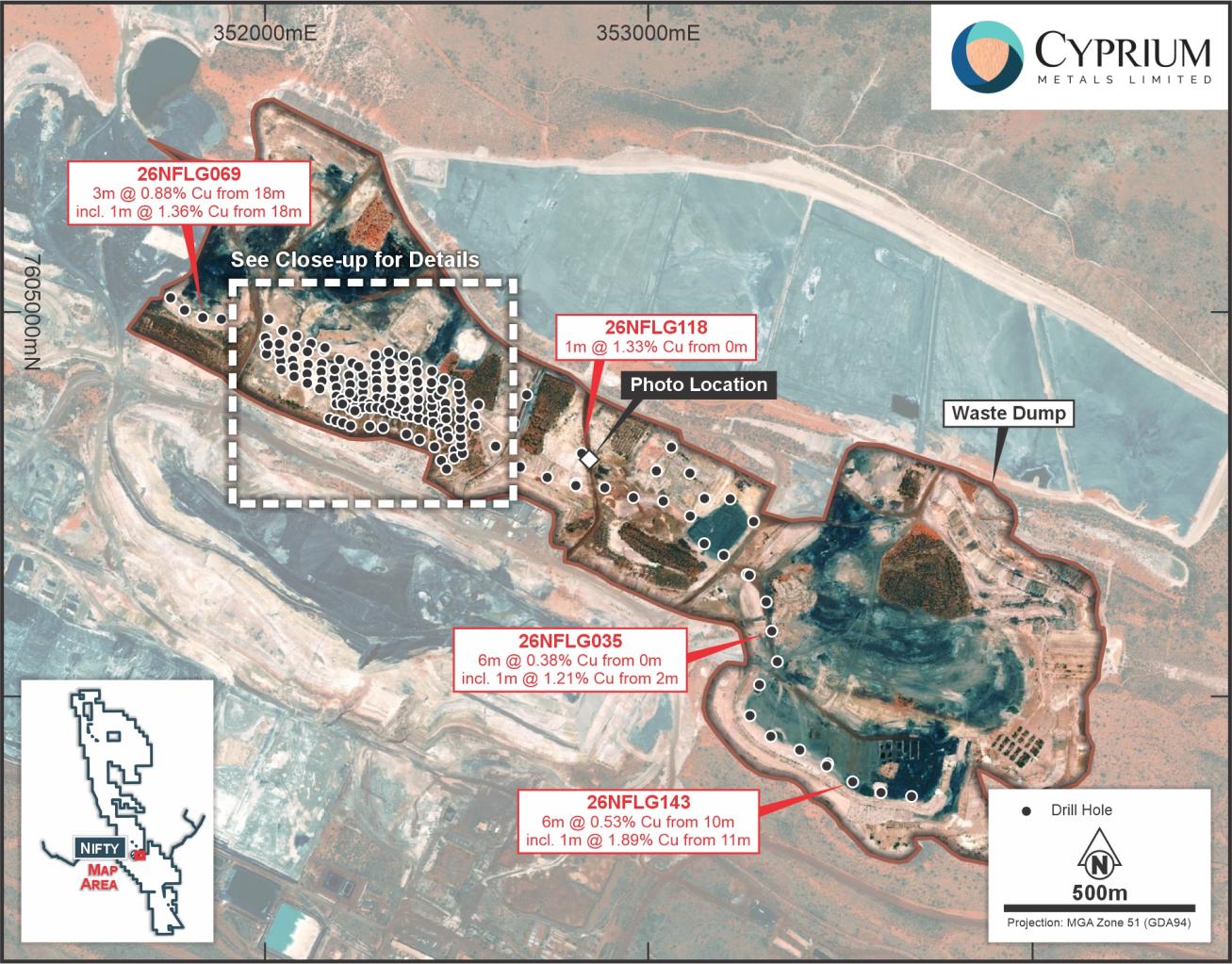
The results come from a recent reverse circulation drilling program targeting visible copper mineralisation within the historical waste dump, located adjacent to the former oxide open pit.
Cyprium said the drilling identified a main mineralised zone over approximately 750m by 250m, with extensions to the mineralisation expected. The company said further drilling will be required to fully define and infill the mineralised zone.
Key results include:
- 9m at 1.00% copper from surface, including 4m at 1.83% copper
- 7m at 1.11% copper from surface, including 3m at 1.55% copper
- 9m at 0.80% copper from surface, including 2m at 1.56% copper
- 7m at 1.03% copper from surface, including 3m at 1.71% copper
- 7m at 0.90% copper from surface, including 3m at 1.50% copper
The drilling program included 133 holes for 2,697m across the main waste dump area, with holes drilled on a 40m by 40m grid and central areas infilled to 20m by 20m.
Cyprium also completed 38 scout holes for 797m along accessible haul roads, with several results requiring follow-up testing.
Executive Chairman Matt Fifield said the discovery of mineralised zones within the historical open pit waste dump was another positive outcome as the company advances work at Nifty.
He said material considered waste or low grade in the 1990s may now have potential economic value under current copper market conditions, equipment capability and technology.
Why it matters: Cyprium is working toward a phased restart of the Nifty Copper Complex. The Phase 1 Cathode Restart involves re-leaching existing above-ground heap leach pads and refurbishing the solvent extraction electrowinning plant to support initial copper cathode production capacity.
The waste dump mineralisation could provide a potential future source of oxide copper feed to the refurbished heap leach and SXEW circuit. Cyprium said the mineralised material is located around 1.2km from the existing heap leach pads via existing haul roads.
This is important because the material is already above ground, potentially making it a lower-cost feed source if metallurgical test work confirms suitable leaching performance.
Cyprium said the Nifty open pit operated between 1993 and 2003, when copper prices were below US$1/lb. The company said visible copper oxide mineralisation, predominantly malachite, is apparent across large sections of the waste dump.
The company is also evaluating broader opportunities to expand cathode production, including near-surface oxide material in the open pit, mineralised zones within the waste dump and potential higher-rate copper recovery from existing pads.
The existing Nifty SXEW plant has two process trains, with the newer “B Train” currently being brought online. Cyprium said future expansion would mainly involve refurbishment of additional cells and mixer settlers in the older and larger “A Train”.
Next steps include further drilling in the core waste dump area, follow-up drilling around scout-hole mineralisation, engagement of an external technical consultant to deliver a maiden Mineral Resource Estimate for the waste dump mineralisation, and metallurgical test work focused on ore sorting and acid leachability.
For Western Australia’s copper sector, the results add another potential feed source to the Nifty restart strategy and highlight the value of reassessing historical material under today’s copper market conditions.
Source: Cyprium Metals ASX announcement, “Drilling Identifies Extensive Copper Mineralisation Within Nifty Waste Dump”, 9 July 2026.